April, before the summer episodes
The Moonlit Return
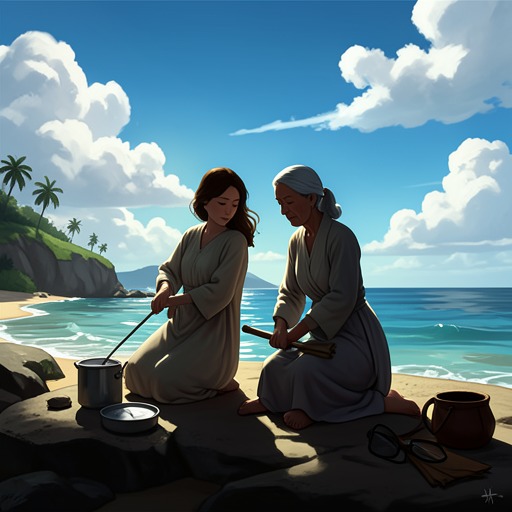
After the family returns to [The family’s island](entity:location-recall-location-the-family-s-island-349e2fb7ae6d), [Sophia](entity:character-recall-character-sophia-b824199f891b) wakes in the night and remembers that her mother is dead and that she now sleeps in a bed of her own. Firelight and reflections transform the icy view into an uncanny landscape, making the familiar room seem doubled and the island ready to drift away.
The same April night
The Open Door
[Sophia](entity:character-recall-character-sophia-b824199f891b) wakes [Grandmother](entity:character-recall-character-grandmother-0f8797f74c19) to ask why she saw two fires in the window and whether the door is shut. Grandmother answers simply, and Sophia lets the imagined island float away as her father rises to feed the stove.
A warm July morning
The False Teeth
After rain, [Grandmother](entity:character-recall-character-grandmother-0f8797f74c19) searches the peonies for her false teeth, and [Sophia](entity:character-recall-character-sophia-b824199f891b) finds them beneath the plants. The intimate discovery turns abruptly toward mortality when Sophia asks when Grandmother will die; Grandmother says it will be soon, but not Sophia’s concern.
Later that July morning
The Forbidden Promontory
[Grandmother](entity:character-recall-character-grandmother-0f8797f74c19) leads [Sophia](entity:character-recall-character-sophia-b824199f891b) toward a ravine that [Sophia’s father](entity:character-recall-character-sophia-s-father-1221baa32ca7) has forbidden them to visit. At the rocky point, Sophia considers swimming in deep water but retreats when she realizes she is alone in it.
The same morning
The Imagined Dive
[Grandmother](entity:character-recall-character-grandmother-0f8797f74c19) vividly describes the sensations of diving, from the seaweed brushing the legs to the ascent into air. [Sophia](entity:character-recall-character-sophia-b824199f891b) asks whether Grandmother believes she can dive without seeing her do it, and Grandmother trusts her, leaving the child’s fear acknowledged rather than forced away.
Spring and early summer
The Magic Forest
On the exposed side of the island, a storm-shaped stand of dead trees survives in a delicate balance. The family first tries to make it more dramatic by adding driftwood, but [Grandmother](entity:character-recall-character-grandmother-0f8797f74c19) quietly returns alone and accepts the forest on its own terms.
Later in the same summer
The Bone Figures
[Grandmother](entity:character-recall-character-grandmother-0f8797f74c19) carves suggestive animals from old wood and gathers bones with [Sophia](entity:character-recall-character-sophia-b824199f891b) along the shore. They arrange the finds in the forest, where an animal skull gleams with its teeth; Sophia is suddenly frightened, and Grandmother comforts her without explaining away the fear.
Early May, before sunrise
The Long-tailed Ducks
Unable to sleep in the cold guest room, [Grandmother](entity:character-recall-character-grandmother-0f8797f74c19) goes out to listen for the long-tailed ducks and wakes [Sophia](entity:character-recall-character-sophia-b824199f891b) to come with her. The spring landscape is still ragged with winter debris, while the birds’ distant calls seem to promise renewal.
Sunrise that same morning
The Dead Bird
They find a dead long-tailed duck on a rock. [Sophia](entity:character-recall-character-sophia-b824199f891b) cannot reconcile its death with [Grandmother](entity:character-recall-character-grandmother-0f8797f74c19)’s account of spring mating, so Grandmother first invents a romantic explanation and then offers a more ordinary accident; the moment lets Sophia test how stories can soften hard facts.
One summer, during Pipsan’s first visit
A Guest Named Berenice
[Sophia](entity:character-recall-character-sophia-b824199f891b)’s first visiting friend, [Pipsan](entity:character-recall-character-pipsan-2cb16e3fa46f), is timid, carefully dressed, and afraid of nearly everything. Sophia appoints herself protector, while she and [Grandmother](entity:character-recall-character-grandmother-0f8797f74c19) give the girl the secret, grand name Berenice and try to plan around her fears.
The first days of Pipsan’s visit
The Island’s Outsider
[Pipsan](entity:character-recall-character-pipsan-2cb16e3fa46f) fears ants and refuses to row, leaving [Sophia](entity:character-recall-character-sophia-b824199f891b) exhausted by the task of watching over her. [Grandmother](entity:character-recall-character-grandmother-0f8797f74c19) recognizes that the island’s settled routines and close-knit household can feel threatening to a newcomer, then invents a game of hiding from supposed intruders that helps Pipsan approach them.
The third day of Pipsan’s visit
The Awful Drawing
After [Sophia](entity:character-recall-character-sophia-b824199f891b) shoves [Pipsan](entity:character-recall-character-pipsan-2cb16e3fa46f) into a dive and laments the damage to her admired hair, [Grandmother](entity:character-recall-character-grandmother-0f8797f74c19) approaches the girl gently among the potato plants. Later, she gives Pipsan paper and asks her to draw something awful; the strange, powerful picture earns Grandmother’s admiration and offers the child a way to express herself.
A hot summer day on the way to the village
Heaven and the Devil
[Sophia](entity:character-recall-character-sophia-b824199f891b) asks whether Heaven resembles a flower-filled pasture and whether it contains [Ants](entity:creature-recall-creature-29b67eaff7cd). Their playful questions about God, angels, and prayer turn into a real argument over Hell and the Devil, exposing the difference between Sophia’s certainty and [Grandmother](entity:character-recall-character-grandmother-0f8797f74c19)’s belief that life itself is difficult enough.
The same walk to the village
The Cowpat Song
After arguing about religious conviction, [Grandmother](entity:character-recall-character-grandmother-0f8797f74c19) steps in a cowpat and tries to end the quarrel with a rude song. [Sophia](entity:character-recall-character-sophia-b824199f891b) is shocked by Grandmother’s language, but learns the song on the way to the shop, and their shared mischief restores their companionship.
A summer Saturday
Building Venice
A postcard of [Venice](entity:location-recall-location-519cfa9fe115) prompts [Grandmother](entity:character-recall-character-grandmother-0f8797f74c19) to describe the city sinking into mud, and [Sophia](entity:character-recall-character-sophia-b824199f891b) begins digging a canal in the marsh pool. They turn the idea into a shared game, building miniature canals, bridges, and palaces among the moss and alder roots.
A stormy night during the Venice game
The Flooded Model City
When wind and rain flood the marsh pool, [Sophia](entity:character-recall-character-sophia-b824199f891b) believes their miniature [Venice](entity:location-recall-location-519cfa9fe115) has sunk and fears its inhabitants are lost. [Grandmother](entity:character-recall-character-grandmother-0f8797f74c19) reassures her, then secretly builds [Grandmother’s Doge’s Palace model](entity:object-recall-object-grandmother-542aef601593) and ages it with water and ashes so the rescued city can carry traces of its imagined disaster.
A rare calm summer day
The Cairn Excursion
The family travels by boat to [The Cairn](entity:location-recall-location-the-cairn-0303e997bace), a distant skerry reached only when the sea is unusually calm. While [Sophia’s father](entity:character-recall-character-sophia-s-father-1221baa32ca7) and [Sophia](entity:character-recall-character-sophia-b824199f891b) wander in separate directions, [Grandmother](entity:character-recall-character-grandmother-0f8797f74c19) slips away from the parasol and finds a quiet crevice of her own.
Later that day at The Cairn
The Channel-Marker Climb
[Sophia](entity:character-recall-character-sophia-b824199f891b) climbs the channel marker despite her father’s prohibition. [Grandmother](entity:character-recall-character-grandmother-0f8797f74c19) sees that she is frightened and, rather than startle her, pretends that she cannot manage without her walking stick, giving Sophia a reason to descend safely.
Immediately after the climb
A Secret for the Deathbed
Once [Sophia](entity:character-recall-character-sophia-b824199f891b) is back on the rock, [Grandmother](entity:character-recall-character-grandmother-0f8797f74c19) praises her courage and asks whether she should tell [Sophia’s father](entity:character-recall-character-sophia-s-father-1221baa32ca7). Sophia says the story can be saved for Grandmother’s deathbed, so it will not go to waste; their joke joins affection to their matter-of-fact awareness of age and death.
Early in one summer
Moppy’s Arrival
A tiny kitten arrives and is fed from [Sophia](entity:character-recall-character-sophia-b824199f891b)’s old baby bottle before growing into a self-possessed cat. [Moppy](entity:character-recall-character-moppy-f7326a30cf66) rejects Sophia’s constant affection and chooses the dish box instead, leading Sophia to observe that loving someone does not guarantee love in return.
A June morning
Moppy’s First Kill
After beginning to hunt, [Moppy](entity:character-recall-character-moppy-f7326a30cf66) brings a dead bird to the house. [Sophia](entity:character-recall-character-sophia-b824199f891b) is horrified and stops speaking to him, while [Grandmother](entity:character-recall-character-grandmother-0f8797f74c19) points out that a wild cat does not distinguish between prey Sophia considers ugly and prey she considers beautiful.
Later that summer
The Hidden Bird Bones
[Moppy](entity:character-recall-character-moppy-f7326a30cf66) continues hunting but learns to conceal his kills beneath the house. [Grandmother](entity:character-recall-character-grandmother-0f8797f74c19) discovers the row of cleaned bird skeletons and withdraws from the cat, while [Sophia](entity:character-recall-character-sophia-b824199f891b) remains caught between anger, guilt, and love for an animal that does not share her moral judgments.
A calm stretch of summer followed by a storm
The Exchange of Cats
The family trades [Moppy](entity:character-recall-character-moppy-f7326a30cf66) for the affectionate white cat Fluff, and [Sophia](entity:character-recall-character-sophia-b824199f891b) enjoys having a pet that sleeps beside her. When Fluff ignores the storm and Sophia’s demands that it hunt, she recognizes that Moppy is the cat she loves despite the pain he causes; the cats are exchanged back.
A summer day on a nearby island
The Secret Cave
[Sophia](entity:character-recall-character-sophia-b824199f891b) reveals a hidden path through dense coastal plants and leads [Grandmother](entity:character-recall-character-grandmother-0f8797f74c19) toward a cave with a moss-covered natural altar. Grandmother is too unwell to enter, so Sophia describes the sacred place and puts Grandmother’s empty [Lupatro](entity:object-recall-object-lupatro-859cf5028715) box on the altar as a small offering.
The same excursion
A Day of Small Rescues
On the return path, [Sophia](entity:character-recall-character-sophia-b824199f891b) and [Grandmother](entity:character-recall-character-grandmother-0f8797f74c19) find mushrooms, a rosebush child to transplant, and a bottle of lemonade in the sand. Sophia celebrates how everything seems to work out, while Grandmother cautions that good fortune should not be pressed too far.
One summer day
The Road Through the Woods
A bulldozer tears through the woods to make a road to the sea, uprooting old trees and crushing moss. [Sophia](entity:character-recall-character-sophia-b824199f891b) watches the familiar landscape become a silent corridor of broken roots and damaged ground, then discovers that the machine has slid into a hollow by the bay.
Just before Midsummer
The Midsummer Invitation
[Eriksson](entity:character-recall-character-eriksson-a3e5e9252f1f) brings a box of damp fireworks and says he will return on [Midsummer](entity:time-recall-time-midsummer-a3e406d30a0c) Eve. The household cleans and decorates the house in anticipation, even though Eriksson is known for brief visits and pays little attention to domestic ceremony.
Midsummer Eve through dawn
The Sea Salvage
Instead of joining a celebration, [Eriksson](entity:character-recall-character-eriksson-a3e5e9252f1f) takes [Grandmother](entity:character-recall-character-grandmother-0f8797f74c19) and [Sophia’s father](entity:character-recall-character-sophia-s-father-1221baa32ca7) out to a salvage operation. Boats gather floating cargo in a coordinated rush while [Sophia](entity:character-recall-character-sophia-b824199f891b) sleeps and Grandmother watches the work; by dawn, the sea is empty and the boats have dispersed.
Midsummer morning
The Ruined Fireworks
Back on the island, [Sophia’s father](entity:character-recall-character-sophia-s-father-1221baa32ca7) sets out the fireworks [Eriksson](entity:character-recall-character-eriksson-a3e5e9252f1f) had left, but nearly all have been ruined by water. One rocket finally rises in blue stars, providing a small, imperfect celebration after the night’s unexpected work at sea.
One summer, during Sophia’s childhood
The Scout Tent
[Sophia’s father](entity:character-recall-character-sophia-s-father-1221baa32ca7) puts a small yellow tent in the ravine, and [Grandmother](entity:character-recall-character-grandmother-0f8797f74c19) reluctantly agrees that it can serve as a Scout tent. [Sophia](entity:character-recall-character-sophia-b824199f891b) asks about Grandmother’s years as a Scout leader, but Grandmother struggles to describe memories that once mattered deeply to her.
That night
Sophia’s Night Alone
[Sophia](entity:character-recall-character-sophia-b824199f891b) sleeps alone in the tent and wakes to the darkness, bird cries, and sounds she cannot identify. She goes to [Grandmother](entity:character-recall-character-grandmother-0f8797f74c19)’s room, where the two talk about what it means to sleep outdoors; Sophia’s account helps Grandmother recover memories of the camping experiences she feared she had lost.
Later that summer
The New House
A businessman builds a large house on [Blustergull Rock](entity:location-recall-location-blustergull-rock-67c7d6992505), disrupting the family’s accustomed horizon and ending their sense of being the outermost residents. [Grandmother](entity:character-recall-character-grandmother-0f8797f74c19) and [Sophia](entity:character-recall-character-sophia-b824199f891b) row over to inspect the property and react sharply to its warning sign, its scale, and its conspicuous decorative choices.
During the inspection of the new house
The Trespass
[Grandmother](entity:character-recall-character-grandmother-0f8797f74c19) removes the shutters’ padlocks and looks inside, insisting that their trespass is a demonstration of disapproval. When [Malander](entity:character-recall-character-malander-1760752cb90c) arrives with his son and dog, Grandmother and [Sophia](entity:character-recall-character-sophia-b824199f891b) flee into the scrub before being found and forced into an awkward introduction.
Immediately after the trespass
The Uncomfortable Welcome
[Malander](entity:character-recall-character-malander-1760752cb90c) welcomes them into the house, and [Grandmother](entity:character-recall-character-grandmother-0f8797f74c19) attempts the social politeness [Sophia](entity:character-recall-character-sophia-b824199f891b) has not yet learned. They discuss solitude, fishing, and the new house; Grandmother sees that Malander wants to be left alone but does not yet understand his own desire, and predicts that he will build a dock regardless of her advice.
During a cold, rainy summer
The Bathrobe’s History
[Sophia’s father](entity:character-recall-character-sophia-s-father-1221baa32ca7)’s old bathrobe, once green and now stiff with age and salt, survives being discarded, washed ashore, inhabited by mice, and scorched by the fire. Stored in the attic, it becomes a vessel of family memory and a source of comfort for [Sophia](entity:character-recall-character-sophia-b824199f891b) when she withdraws from the household.
Later in the rainy summer
The Creature in the Robe
During a rebellious spell, [Sophia](entity:character-recall-character-sophia-b824199f891b) imagines something alive hiding inside the bathrobe and keeps the supposed danger secret. When her father goes to the village during rising wind, her fear and distress overwhelm her, and she demands the robe as a refuge.
That same stormy afternoon
The Robe’s Return
[Grandmother](entity:character-recall-character-grandmother-0f8797f74c19) climbs into the attic, retrieves the robe, and shakes out the imagined creature, which slips away beneath the door. The robe’s familiar smell and weight calm [Sophia](entity:character-recall-character-sophia-b824199f891b); Grandmother waits by the window until [Sophia’s father](entity:character-recall-character-sophia-s-father-1221baa32ca7) returns safely through the rough water.
A spring after the family’s return to the island
The Imported Garden
[Sophia’s father](entity:character-recall-character-sophia-s-father-1221baa32ca7) begins transforming the island with Dutch bulbs, imported plants, and inland soil. He cuts into the natural turf, digs new beds, and reshapes the marsh pond, while [Grandmother](entity:character-recall-character-grandmother-0f8797f74c19) worries that the project is damaging a landscape that had sustained itself without such care.
Early summer, after the imported garden takes hold
The Island’s Drought
With no rain, [Sophia’s father](entity:character-recall-character-sophia-s-father-1221baa32ca7) uses a pump and stored water to keep the imported plants alive, while the island’s native turf dries and spruces die. The water basin empties, turning a garden project into a crisis for both the new plantings and the island’s older ecology.
At the height of the drought
The Water Sausage
[Sophia’s father](entity:character-recall-character-sophia-s-father-1221baa32ca7) brings home an enormous plastic container designed to carry water from a bog. After filling it, the family struggles to tow the heavy, mud-laden load through shallow water, with the boat taking on water as a storm approaches.
The same day, as the storm breaks
Rain for the Island
The family reaches the island and pumps water from the container into the parched garden just as rain begins to fall. [Sophia](entity:character-recall-character-sophia-b824199f891b) celebrates the water reaching the plants and the thirsty island, while [Grandmother](entity:character-recall-character-grandmother-0f8797f74c19), delighted by the abundance, pours precious drinking water over a daisy.
One still August night
The Party That Was Missed
A brightly lit yacht anchors near the island, and [Sophia](entity:character-recall-character-sophia-b824199f891b) hopes to join its apparent party. [Sophia’s father](entity:character-recall-character-sophia-s-father-1221baa32ca7) goes to the boat but does not fetch them; the yacht leaves before morning, and Sophia grieves the missed celebration while [Grandmother](entity:character-recall-character-grandmother-0f8797f74c19) condemns his conduct.
The morning after the yacht leaves
The Crooks’ Apology
[Grandmother](entity:character-recall-character-grandmother-0f8797f74c19) and [Sophia](entity:character-recall-character-sophia-b824199f891b) invent increasingly elaborate explanations for the yacht’s visitors, including a story that they are criminals. A box of chocolates arrives with a note apologizing to those too old and too young to join the party; Sophia wants to forgive the visitors, while Grandmother refuses, and they wonder whether [Sophia’s father](entity:character-recall-character-sophia-s-father-1221baa32ca7) was drugged.
Late summer
The Cancelled Departure
[Sophia](entity:character-recall-character-sophia-b824199f891b) learns that the family may have to leave for a week, and [Grandmother](entity:character-recall-character-grandmother-0f8797f74c19) feels excluded and falls into a quiet despondency. Their usual routines cease to bridge the distance between them, and Sophia’s correctly spelled letter declaring hatred makes their estrangement explicit.
A calm evening later in August
Verner’s Visit
[Verner](entity:character-recall-character-verner-3b8a9640ee9e) arrives with the sherry he has brought [Grandmother](entity:character-recall-character-grandmother-0f8797f74c19) for years, though she has never liked it. Their conversation shifts from old age and death to the demands relatives place on him; Verner admits he took a boat and left because he feels treated as a responsibility rather than a person.
Later in the same visit
Verner’s Wish to Grow
[Verner](entity:character-recall-character-verner-3b8a9640ee9e) says he would rather make things with his hands than collect the hobbies other people prescribe. [Grandmother](entity:character-recall-character-grandmother-0f8797f74c19) suggests growing things, and he recognizes that he must arrive at the idea himself; she sends him home with encouragement to find a way around his relatives’ control.
One summer, after Sophia becomes afraid of small animals
The Book of Angleworms
[Sophia](entity:character-recall-character-sophia-b824199f891b)’s new terror of small creatures intensifies when her spade cuts an Angleworm in two. [Grandmother](entity:character-recall-character-grandmother-0f8797f74c19) reassures her and suggests writing about the animal; Sophia begins dictating [A Study of Angleworms That Have Come Apart](entity:object-recall-object-41840fb6b804), turning fear into an inquiry about pain, separation, and survival.
The evenings following the first chapter
Other Pitiful Animals
[Sophia](entity:character-recall-character-sophia-b824199f891b) dictates further reflections on moths, daddy-longlegs, fish, crayfish, and [Field mice](entity:creature-recall-creature-918f8ad3e4ae), dwelling on how creatures suffer and how people often cause harm without knowing how to help. She leaves the unfinished book for her future children, making a child’s imaginative project into a record of her moral unease.
The summer of the great storm, around midday
The Great Storm Begins
On a trip to [North Grey-skerry](entity:location-recall-location-north-grey-skerry-676d54c82b78), the family experiences unusual heat, a yellow haze, and a heavy swell. [Sophia’s father](entity:character-recall-character-sophia-s-father-1221baa32ca7) falls asleep while [Grandmother](entity:character-recall-character-grandmother-0f8797f74c19) and [Sophia](entity:character-recall-character-sophia-b824199f891b) explore the abandoned pilots’ cottage; bored and wanting something to happen, Sophia prays for a storm.
That afternoon
Sophia’s Storm
The swallows fall silent, the horizon darkens, and a powerful storm reaches the skerry. [Sophia](entity:character-recall-character-sophia-b824199f891b) runs into the wind, convinced that her prayer has summoned it, while her father struggles to save the fishing nets and bring the boat ashore.
That evening
Shelter in the Pilots’ Cottage
The family breaks into the abandoned cottage to escape the storm. Waves and spray batter the building, [Sophia’s father](entity:character-recall-character-sophia-s-father-1221baa32ca7) repeatedly checks the boat, and the three eat what they brought while [Grandmother](entity:character-recall-character-grandmother-0f8797f74c19) sorts fish from the net.
Later that night
The Fear of Responsibility
[Sophia](entity:character-recall-character-sophia-b824199f891b)’s excitement turns to terror when [Grandmother](entity:character-recall-character-grandmother-0f8797f74c19) lists the boats, garden pots, and other things that may be lost in the storm. Sophia believes she caused the danger by praying, and Grandmother invents a counterclaim: she had prayed for a storm first.
The following afternoon
The Storm’s Aftermath
The family returns when the wind eases and finds the dory and most of their belongings safe. A helicopter records their names and the island’s name, while the storm becomes a shared memory that can be admired because everyone survived.
A very hot day near a full moon
The Dancing Midges
[Grandmother](entity:character-recall-character-grandmother-0f8797f74c19) tells [Sophia](entity:character-recall-character-sophia-b824199f891b) that [Midges](entity:creature-recall-creature-midges-7877fd42eb38) dancing in columns are a sign of a dangerous mating day, when people should avoid tempting fate. Sophia questions the superstition, but as ordinary events begin to resemble the old warnings, she grows increasingly anxious about her father.
That evening, before the full moon sets
The Crossed Implements
[Sophia](entity:character-recall-character-sophia-b824199f891b) discovers that a knife and pen lie crossed on her father’s desk, an omen her great-grandmother associated with death. Though [Grandmother](entity:character-recall-character-grandmother-0f8797f74c19) explains that the older woman used superstition to frighten her family, Sophia refuses reassurance and searches for herbs to protect her father.
The same moonlit night
The Protective Pocket Charm
To calm [Sophia](entity:character-recall-character-sophia-b824199f891b), [Grandmother](entity:character-recall-character-grandmother-0f8797f74c19) gathers ordinary objects—a plant head, pebbles, grass, moss, fern, and a dead moth—and tells her not to speak until the ingredients are safely put away. The improvised ritual settles Sophia, and Grandmother keeps the objects in her pocket; when she later sends her coat to be cleaned, her father soon sprains his ankle.
August, near the end of summer
The Island Begins to Empty
The bright nights fade, and the family gradually moves tools, boats, garden equipment, and supplies toward the house as they prepare to leave. [Grandmother](entity:character-recall-character-grandmother-0f8797f74c19) tidies the island and worries about whoever might arrive after them, leaving instructions and provisions for possible visitors.
A dark night at the end of August
Grandmother’s Last Night Outside
As the island grows dark and quiet, [Grandmother](entity:character-recall-character-grandmother-0f8797f74c19) finds it increasingly difficult to move around in the night. She sits in the woodyard and mistakes the sound of her own heart for a boat heading out to sea, then stays where she is for a while, attentive to the island she is about to leave.